

 PIPAVO Team
Learn what a forex trading system is, how it works, key components, risks, and how to build one with clear rules and discipline.
In this article
Introduction
A forex trading system is a structured set of rules that guides when to enter, manage, and exit currency trades. It helps traders make decisions more consistently instead of relying on emotions or guesswork. In this guide, you will learn how forex trading systems work, what they include, their main types, and how to build one responsibly with risk management at the center.
What Is a Forex Trading System?
A forex trading system is a rules-based approach to trading currency pairs. It defines the conditions a trader uses to identify opportunities, control risk, manage open positions, and close trades.
A system can be simple or complex. For example, a beginner may use a basic trend-following system with moving averages, while an advanced trader may use a multi-factor model that includes technical indicators, economic data, volatility filters, and automated execution.
The key point is that a forex trading system removes as much uncertainty as possible from the decision-making process. It does not predict the market perfectly. Instead, it creates a repeatable framework for taking trades only when specific conditions are met.

Why Forex Traders Use Trading Systems
Forex markets move quickly, and prices can be influenced by interest rates, inflation data, central bank policy, geopolitical events, liquidity, and market sentiment. Without a structured approach, traders may overtrade, chase price moves, or hold losing trades too long.
A forex trading system helps by creating consistency. It gives the trader a predefined process before market pressure appears. This can support better discipline and reduce impulsive decisions.
A trading system can help traders:
- Define clear entry and exit rules
- Set risk limits before placing trades
- Avoid random decision-making
- Track performance over time
- Review whether a strategy is working
- Improve discipline during volatile markets
However, a system is not a guarantee of success. Even a well-designed forex trading strategy can experience losses, drawdowns, and periods of poor performance.
Forex Trading System vs. Forex Trading Strategy
The terms forex trading system and forex trading strategy are often used together, but they are not exactly the same.
A forex trading strategy usually refers to the method used to find trade opportunities. For example, a trader may use a breakout strategy, trend-following strategy, range-trading strategy, or news-based strategy.
A forex trading system is broader. It includes the strategy, but it also covers risk management, position sizing, trade execution, exit rules, recordkeeping, and performance review.
In simple terms:
- A strategy tells you what kind of trade to look for.
- A system tells you how to trade it from start to finish.

Key Components of a Forex Trading System
A complete forex trading system usually includes several connected parts. Each part should be clear enough that another trader could understand the rules without guessing.
1. Market Selection
The system should define which currency pairs you trade. Some traders focus only on major pairs such as EUR/USD, GBP/USD, USD/JPY, or USD/CHF because they tend to have high liquidity. Others include minor or exotic pairs, which may have wider spreads and different volatility patterns.
A beginner may benefit from focusing on a small number of liquid pairs before expanding.
Claim to source if expanded: Any statement comparing average spreads, daily trading volume, or liquidity by pair should be supported by broker data, BIS reports, or reputable market research.
2. Time Frame
A trading system should specify the chart time frames used for analysis and execution. Common examples include:
- Scalping: 1-minute to 5-minute charts
- Day trading: 5-minute to 1-hour charts
- Swing trading: 4-hour to daily charts
- Position trading: daily to weekly charts
The chosen time frame affects trade frequency, risk exposure, stress level, and transaction costs.
3. Entry Rules
Entry rules define when a trader opens a position. These rules may be based on technical analysis, price action, indicators, fundamental factors, or a combination of methods.
Examples of entry conditions include:
- Price breaks above a resistance level
- A moving average crossover confirms trend direction
- RSI moves out of oversold or overbought territory
- Price pulls back to a support zone in an uptrend
- A major economic event creates a volatility setup
The best entry rules are specific. “Buy when the market looks strong” is too vague. “Buy when price closes above the 50-period moving average and the higher time frame trend is upward” is clearer.

4. Exit Rules
Exit rules are just as important as entry rules. A forex trading system should define when to close a trade for both profit and loss.
Exit rules may include:
- Stop-loss levels
- Take-profit targets
- Trailing stops
- Time-based exits
- Indicator-based exits
- Manual exits after invalidation of the setup
Without exit rules, traders may make emotional decisions after the trade is already open.
5. Risk Management Rules
Forex risk management is one of the most important parts of any trading system. It defines how much capital is at risk on each trade and how losses are controlled.
Common risk management rules include:
- Risking only a small percentage of account equity per trade
- Using stop-loss orders
- Avoiding excessive leverage
- Limiting the number of open positions
- Setting a maximum daily, weekly, or monthly loss limit
- Avoiding trades before high-impact news if the system is not designed for news volatility
Many traders use fixed fractional risk, such as risking a small percentage of account balance per trade. The exact percentage depends on the trader’s experience, account size, strategy, and risk tolerance.
Claim to source if expanded: Any specific recommendation such as “risk 1% per trade” should be presented as a common educational example, not a universal rule, and ideally supported by reputable trading education or risk management sources.
6. Position Sizing
Position sizing determines how large each trade should be. It connects the stop-loss distance with the amount of money the trader is willing to risk.
For example, if a trader risks a fixed amount and uses a wider stop-loss, the position size should usually be smaller. If the stop-loss is tighter, the position size may be larger, assuming the same risk amount.
This helps prevent one trade from carrying much more risk than intended.
7. Trade Management
Trade management covers what happens after a trade is opened. A system may define whether the trader moves the stop-loss, takes partial profits, closes before news, or lets the trade run until the original target.
Trade management rules should be written before entering a position. Changing them during a trade can lead to inconsistent results.
8. Performance Tracking
A forex trading system should include a way to record and review trades. A trading journal can track entries, exits, risk, trade rationale, emotional state, screenshots, and results.
Over time, this data helps traders identify patterns. For example, a trader may discover that their system performs better during trending markets than range-bound markets, or that certain currency pairs create more false signals.

Main Types of Forex Trading Systems
Forex trading systems can be grouped in several ways. The right type depends on the trader’s goals, schedule, experience, and risk tolerance.
Manual Forex Trading System
A manual system requires the trader to analyze the market and place trades personally. The rules may be structured, but the trader still makes the final decision.
Manual systems can provide flexibility, but they also require discipline. Traders must avoid ignoring rules when emotions are high.
Automated Forex Trading System
An automated forex trading system uses software to identify signals and execute trades according to programmed rules. These systems are often called trading robots, expert advisors, or algorithmic trading systems.
Automation can reduce emotional decision-making and execute trades quickly. However, automated systems still carry risk. They can fail during unusual market conditions, technical issues, poor programming, or over-optimization.
Claim to source if expanded: Any claim about the percentage of forex volume traded algorithmically should be supported by credible market structure research or institutional reports.
Trend-Following System
A trend-following system aims to trade in the direction of the broader market trend. It may use moving averages, trendlines, price structure, or momentum indicators.
The goal is to capture part of a sustained price move. These systems may perform better in trending conditions but can struggle when markets move sideways.
Range-Trading System
A range-trading system looks for price movement between support and resistance levels. Traders may buy near support and sell near resistance, assuming the range remains intact.
This type of system can work in calm or sideways markets, but it may suffer losses when price breaks out strongly.
Breakout System
A breakout system enters trades when price moves beyond a defined level, such as resistance, support, or a consolidation zone.
Breakout systems can capture strong moves, but false breakouts are common. A reliable system should define confirmation rules, stop-loss placement, and conditions that invalidate the setup.

News-Based System
A news-based system uses economic releases, central bank decisions, or geopolitical events to identify trading opportunities.
This approach can involve significant volatility and slippage. It is generally more suitable for experienced traders who understand economic calendars, liquidity conditions, and event risk.
How to Build a Forex Trading System
Building a forex trading system requires more than choosing an indicator. A complete system should be documented, tested, reviewed, and improved carefully.
Step 1: Define Your Trading Objective
Start by identifying what the system is designed to do. For example:
- Trade short-term momentum
- Capture medium-term trends
- Trade range-bound markets
- Avoid high-volatility news events
- Focus on one or two major currency pairs
A clear objective helps prevent mixing too many unrelated ideas into one system.
Step 2: Choose Your Market and Time Frame
Select the currency pairs and time frames that match your schedule and trading style. A day trader may need to monitor charts frequently, while a swing trader may review the market less often.
The system should fit your real life. A complex intraday system may not be practical for someone who cannot watch markets during active trading hours.
Step 3: Write Entry and Exit Rules
Write down exact conditions for entering and exiting trades. The rules should be objective enough to test.
For example:
- Trade only in the direction of the 200-period moving average
- Enter after a pullback and bullish confirmation candle
- Place the stop-loss below the recent swing low
- Take profit at a defined risk-reward target or trailing stop
This is only an example, not a recommendation. Every trader should test whether a rule set is suitable for their own situation.
Step 4: Add Risk Management
Before testing a system, define risk rules. These may include maximum risk per trade, maximum number of trades per day, and maximum loss limits.
Risk management should not be added after a losing streak. It should be part of the system from the beginning.
Step 5: Backtest the System
Backtesting means reviewing historical price data to see how the system would have performed under past market conditions.
Backtesting can help identify strengths and weaknesses, but it has limitations. Past performance does not guarantee future results. Data quality, execution assumptions, spreads, slippage, and changing market conditions can all affect real-world outcomes.
Claim to source if expanded: Any backtest results, win rates, average returns, or drawdown figures must be sourced from the actual test data and methodology.
Step 6: Forward Test on a Demo Account
Forward testing means applying the system in live market conditions without risking real money, often through a demo account.
This can reveal practical issues that backtesting may miss, such as hesitation, execution delays, spread widening, or difficulty following rules consistently.
Step 7: Review and Refine Carefully
A trading system should be reviewed regularly, but not changed impulsively after every loss. Losses are normal in trading. The goal is to determine whether the system is performing within expected limits or whether market conditions have changed.
Avoid over-optimizing a system to fit past data too perfectly. A system that looks excellent in historical testing may perform poorly in live conditions if it was curve-fitted.

Example of a Simple Forex Trading System
Below is a basic educational example of how a forex trading system might be structured. This is not a recommendation or trading advice.
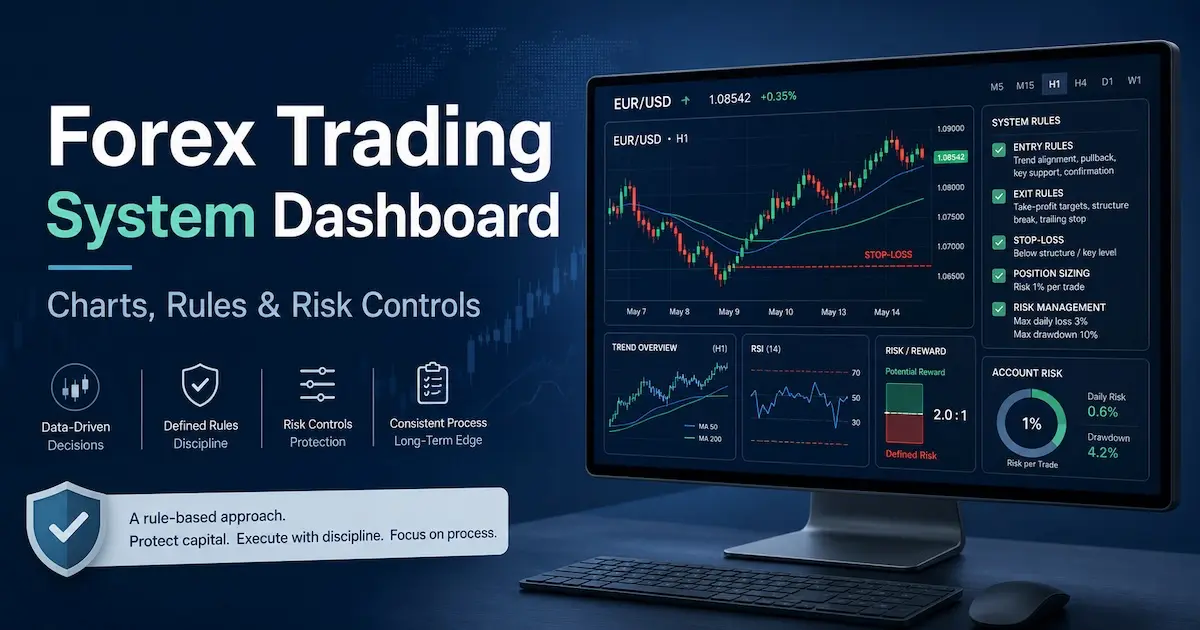
Example: Basic Trend-Pullback System
Market: EUR/USD
Time frame: 1-hour chart
Trend filter: Price above the 200-period moving average
Setup: Price pulls back toward the 50-period moving average
Entry: Bullish candle closes above the 50-period moving average
Stop-loss: Below the recent swing low
Take-profit: Based on a predefined risk-reward ratio or trailing stop
Risk rule: Fixed percentage risk per trade
Avoid: High-impact news events if the system has not been tested during news conditions
The value of this example is not the specific indicator combination. The value is the structure. The system defines what to trade, when to enter, where to exit, and how to manage risk.

Common Mistakes When Using a Forex Trading System
Even a well-designed system can fail if it is used incorrectly. Many problems come from poor discipline, unrealistic expectations, or weak risk control.
Changing Rules Too Often
Some traders abandon a system after a few losing trades. This can make it impossible to know whether the system is genuinely flawed or simply going through a normal losing period.
Ignoring Risk Management
A system with strong entries can still lead to large losses if position sizes are too large or stop-loss rules are ignored.
Over-Relying on Indicators
Indicators can help structure decisions, but they are not perfect. Many indicators are based on past price data and can lag behind current market movement.
Using Too Much Leverage
Leverage can increase both gains and losses. In forex, excessive leverage can cause rapid account losses, especially during volatile market conditions.
Expecting Consistent Profits
No forex trading system wins all the time. Markets change, and every system can experience drawdowns. Traders should focus on process, risk control, and long-term review rather than expecting every trade to be profitable.
How to Evaluate a Forex Trading System
Before using a forex trading system with real money, evaluate it carefully.
Important factors include:
- Clear and testable rules
- Realistic risk management
- Historical testing across different market conditions
- Forward testing in a demo environment
- Reasonable transaction cost assumptions
- Defined maximum drawdown expectations
- Compatibility with your schedule and temperament
- Transparent performance tracking
Be cautious with any system that promises guaranteed profits, extremely high win rates, or “risk-free” trading. Forex trading involves risk, and no system can remove uncertainty.
Manual vs. Automated Forex Trading Systems
Both manual and automated systems can be useful, but they have different strengths and weaknesses.
A manual forex trading system may suit traders who want flexibility and context-based decision-making. It allows the trader to consider market conditions that may be difficult to code.
An automated forex trading system may suit traders who want consistent execution of predefined rules. It can be useful when rules are objective and programmable.
However, automation does not remove risk. Automated systems still need monitoring, testing, and proper risk controls. Technical failures, poor settings, data issues, and unexpected market conditions can all affect performance.

Is a Forex Trading System Suitable for Beginners?
A forex trading system can be useful for beginners because it encourages structure and discipline. However, beginners should start with education, demo testing, and risk awareness before trading real money.
A beginner-friendly system should be simple, rule-based, and easy to review. It should not rely on too many indicators or complex signals. The goal is to learn how markets behave, how risk works, and how to follow a plan consistently.
Beginners should also understand that trading forex is speculative. Losses are possible, and using leverage can increase risk.
Frequently Asked Questions
A forex trading system is a structured set of rules for entering, managing, and exiting currency trades. It usually includes entry signals, exit rules, risk management, position sizing, and performance tracking.
Not exactly. A forex trading strategy focuses on how to find trade opportunities, while a forex trading system includes the full process, including risk management, execution, trade management, and review.
No. No forex trading system can guarantee profits. Currency markets are uncertain, and every system can experience losses, drawdowns, or poor performance in certain market conditions.
Beginners should be cautious with automated systems. Automation can execute rules consistently, but it does not remove trading risk. Any automated system should be tested, monitored, and understood before real money is used.
A system should be evaluated through clear rules, backtesting, demo forward testing, realistic cost assumptions, and ongoing performance review. Past performance does not guarantee future results.
Conclusion + CTA
A forex trading system gives traders a structured way to approach the currency market. It defines what to trade, when to enter, how to manage risk, and when to exit. While a system can support consistency and discipline, it cannot remove uncertainty or guarantee profitable results.
Before using any forex trading system with real money, document the rules, test them carefully, and make sure the risk level matches your financial situation and experience.
CTA: Continue learning by building a written trading plan and reviewing the basics of forex risk management before placing live trades.
Risk Disclaimer
Forex trading involves significant risk and may not be suitable for all investors. The use of leverage can magnify both gains and losses. Past performance, backtesting results, or demo trading outcomes do not guarantee future results. This article is for educational purposes only and should not be considered financial, investment, tax, or legal advice. Consider consulting a qualified financial professional before making trading decisions.