

 PIPAVO Team
Learn what Smart Money Concepts and ICT mean in forex, how traders use liquidity, order blocks and fair value gaps, plus key risks.
In this article
Smart Money Concepts (SMC) and ICT are price-action frameworks used by forex traders to study market structure, liquidity, and possible institutional order-flow clues. They do not predict markets with certainty, but they give traders a structured way to interpret why price may move between key levels. This guide explains what SMC and ICT mean, how their core ideas work, and the risks traders should understand before using them.
What Are Smart Money Concepts?

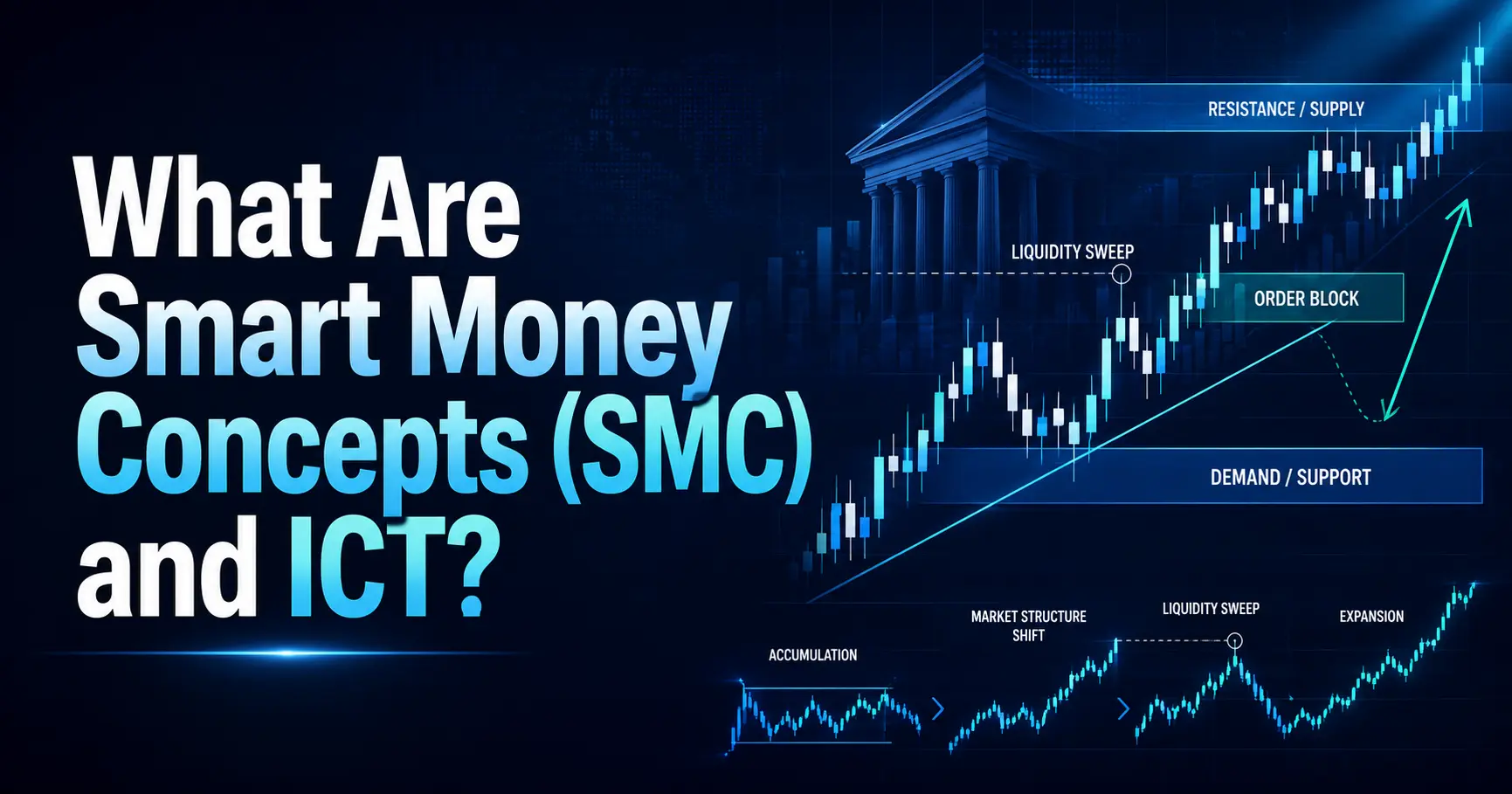
Smart Money Concepts is a trading approach that focuses on how price may move around liquidity, market structure, and areas where larger market participants could be active. In simple terms, SMC traders try to understand where orders may be clustered and how price reacts around those zones.
The phrase “smart money” usually refers to large or informed market participants, such as banks, institutions, hedge funds, or professional traders. However, retail traders cannot see all institutional orders directly on a standard forex chart. For that reason, SMC should be understood as a price-action interpretation model, not as proof that a specific institution is buying or selling.
SMC traders often look at:
- Market structure: The sequence of higher highs, higher lows, lower highs, and lower lows.
- Liquidity: Areas where many stop-loss or pending orders may sit, such as above equal highs or below equal lows.
- Order blocks: Price zones that traders interpret as possible areas of institutional buying or selling.
- Fair value gaps: Imbalances or inefficient price moves that price may later revisit.
- Displacement: A strong directional move that suggests momentum has entered the market.
The goal is not to guess every market move. The goal is to build a repeatable framework for reading price, waiting for confirmation, and managing risk.
What Is ICT?

ICT stands for Inner Circle Trader, a trading education brand associated with Michael J. Huddleston. His official site identifies him as Michael J. Huddleston, also known as The Inner Circle Trader, and describes him as the author of many trading concepts used by forex traders.
ICT trading is closely related to Smart Money Concepts, but it is usually treated as a more specific methodology. ICT-style traders often study price through concepts such as liquidity pools, fair value gaps, order blocks, premium and discount zones, kill zones, market maker models, and time-based setups.
In practice, many traders use “SMC” and “ICT” interchangeably. That can be confusing. A helpful distinction is this:
SMC is the broader category. ICT is a specific teaching style and framework inside that broader price-action world.
Neither SMC nor ICT should be treated as a guaranteed trading system. They are analytical frameworks. Their quality depends on how clearly a trader defines rules, tests setups, manages risk, and avoids hindsight bias.
SMC vs ICT: Are They the Same?

SMC and ICT overlap heavily, but they are not always identical. Many SMC traders use ICT terminology, while some traders use simplified SMC concepts without following the full ICT methodology.
| Area | Smart Money Concepts | ICT Trading |
|---|---|---|
| Scope | Broad price-action framework | More specific methodology |
| Main focus | Liquidity, structure, order flow interpretation | Liquidity, time, price delivery, specific models |
| Common tools | Order blocks, BOS, CHoCH, FVG, liquidity sweeps | FVG, order blocks, kill zones, PD arrays, premium/discount |
| Learning curve | Moderate | Moderate to advanced |
| Best use | Understanding price context | Building structured entry models |
The most important point is that both approaches require discipline. A trader who labels every candle as an order block or every gap as a trade opportunity is not using the framework carefully. Good analysis needs context, invalidation, and risk control.
Key SMC and ICT Concepts Explained

Market structure
Market structure describes the direction and behavior of price. In an uptrend, price usually forms higher highs and higher lows. In a downtrend, price usually forms lower highs and lower lows.
SMC and ICT traders pay close attention to changes in structure. Two common terms are:
Break of Structure (BOS): Price breaks a previous swing point in the direction of the trend.
Change of Character (CHoCH): Price breaks structure in a way that may suggest the current trend or short-term direction is changing.
These terms are useful, but they can be subjective. Traders may disagree on which swing high or swing low matters most. That is why many traders combine structure with higher-timeframe context.
Liquidity
Liquidity refers to the availability of buy and sell orders in the market. In SMC and ICT analysis, traders often mark areas where stop-loss orders may be clustered. These areas can include:
- Above previous highs
- Below previous lows
- Above equal highs
- Below equal lows
- Around obvious support and resistance zones
A liquidity sweep happens when price moves beyond a visible high or low, triggers orders, and then reverses. Traders sometimes interpret this as a sign that price has collected liquidity before moving in the opposite direction.
This does not prove manipulation. It simply describes a price behavior that traders can observe on a chart.
Fair value gap
A fair value gap, often shortened to FVG, is an imbalance created by a fast price move. On a candlestick chart, it appears when price moves strongly in one direction and leaves a gap-like area between candles.
SMC and ICT traders may watch these areas because price sometimes retraces into them before continuing. A fair value gap is not automatically a trade signal. It is a zone of interest that needs context, such as trend direction, liquidity, and risk-reward.
Order block
An order block is a price zone that traders interpret as the last opposing candle or consolidation area before a strong move. For example, in a bullish setup, traders may look for the last bearish candle before a strong upward displacement.
The idea is that this zone may act as a future reaction area. However, not every order block will hold. Some will fail immediately. Others may work only when aligned with higher-timeframe structure or nearby liquidity.
Displacement
Displacement is a strong move away from a level. It often appears as large candles with little overlap. In SMC and ICT analysis, displacement may be used as confirmation that price has moved decisively after taking liquidity or breaking structure.
Displacement is important because it helps traders avoid entering too early. Instead of assuming a reversal, they wait for price to show intent.
Example: How a Trader Might Use SMC in Forex

Here is a simplified educational example. This is not a recommendation to buy or sell any currency pair.
A trader is watching a forex pair that has been trending upward on the higher timeframe. Price pulls back and forms equal lows near a previous support area. The trader marks those equal lows as possible sell-side liquidity.
Next, price briefly breaks below the equal lows, then quickly moves back above them. This is the liquidity sweep. The trader does not enter yet.
After the sweep, price creates a strong bullish move and breaks a minor swing high. This may indicate a short-term market structure shift. During that move, a fair value gap forms.
The trader then waits to see whether price retraces into the fair value gap or a nearby bullish order block. If it does, the trader may look for a valid entry based on their rules. The invalidation level could be below the liquidity sweep low.
A structured plan would include:
- The reason for the trade
- The entry zone
- The stop-loss or invalidation level
- The target area
- The maximum account risk
- Conditions that cancel the setup
Without those rules, SMC can become too subjective.
Strengths of SMC and ICT

SMC and ICT can help traders think more clearly about price behavior. Instead of reacting to every candle, traders can focus on structure, liquidity, and planned zones.
Potential benefits include:
Clearer chart context: Traders learn to map important highs, lows, and reaction zones.
Better patience: Waiting for liquidity sweeps, displacement, or retracements can reduce emotional entries.
Defined invalidation: Many SMC setups use clear levels where the trade idea is no longer valid.
Less reliance on indicators: SMC and ICT are mainly price-action based, which can appeal to traders who prefer cleaner charts.
These benefits depend on execution. A concept is only useful if it becomes a tested and repeatable process.
Limitations and Common Mistakes
SMC and ICT also have important limitations. The biggest issue is subjectivity. Two traders can look at the same chart and mark different order blocks, fair value gaps, or liquidity zones.
Common mistakes include:
- Seeing setups everywhere: Not every sweep, gap, or candle pattern is meaningful.
- Ignoring the higher timeframe: A lower-timeframe setup can fail if it fights stronger market structure.
- Entering before confirmation: Anticipating a reversal before displacement can increase false entries.
- Using too much leverage: Even a good analysis can fail, and leverage can make losses grow quickly.
- Believing the method is certain: No trading framework removes risk.
Forex trading itself carries significant risk. The SEC notes that forex trading can be very risky, is not appropriate for all investors, and commonly involves leverage that can magnify both gains and losses.
Risk Management for SMC and ICT Traders

Risk management should come before any entry model. A trader can understand SMC well and still lose money if position sizing, leverage, or emotional control is poor.
A basic risk plan should include:
- Risking only a small, predefined percentage of capital per trade
- Using a stop-loss or clear invalidation level
- Avoiding revenge trading after losses
- Keeping a trading journal
- Testing setups on historical charts and demo accounts
- Avoiding oversized positions during news events
- Understanding broker spreads, slippage, and execution risks
In the U.S., retail forex rules require risk disclosures for certain retail forex accounts, and official disclosure language warns that off-exchange foreign currency transactions involve leveraged trading and can lead to rapid losses, including losses greater than the amount deposited.
Traders should also be cautious with anyone promoting guaranteed results, secret institutional signals, or unusually large returns with little downside. The CFTC and NASAA warn that forex fraud often uses sophisticated-sounding offers and promises of large returns with little or no risk.
Should Beginners Learn SMC and ICT?
Beginners can learn SMC and ICT, but they should start slowly. These frameworks use many terms, and it is easy to overcomplicate a chart.
A good learning path is:
- Learn basic candlestick structure.
- Understand support, resistance, and trend.
- Study liquidity around highs and lows.
- Learn market structure shifts.
- Add fair value gaps and order blocks.
- Build one simple setup.
- Test it before risking real money.
The goal is not to memorize every term. The goal is to build a clear process that can be reviewed and improved.
Editorial Claims to Source or Avoid
Before publishing, avoid or source the following types of claims:
- “SMC has a high win rate” — needs verified backtest or account data.
- “Banks hunt retail traders’ stops” — should be phrased as a market interpretation unless supported by credible evidence.
- “ICT is the most accurate forex strategy” — promotional and unsupported.
- “This setup works in all market conditions” — unrealistic and risky.
- “Most traders lose because they do not understand liquidity” — needs credible data and careful wording.
A safer phrasing is: “SMC and ICT traders use liquidity as a framework for interpreting price movement, but the method does not guarantee accuracy.”
Frequently Asked Questions
SMC stands for Smart Money Concepts. It is a price-action approach that studies market structure, liquidity, order blocks, fair value gaps, and possible areas where larger market participants may influence price.
ICT stands for Inner Circle Trader. It is associated with Michael J. Huddleston and refers to a specific trading education framework that includes concepts such as liquidity, fair value gaps, order blocks, kill zones, and premium/discount zones.
They are closely related, but not exactly the same. SMC is a broader term used by many traders, while ICT usually refers to a more specific methodology and vocabulary associated with Inner Circle Trader teachings.
Smart Money Concepts are not automatically profitable. Profitability depends on the trader’s rules, testing, execution, risk management, costs, and market conditions. No SMC or ICT setup can guarantee profits.
ICT trading can be difficult for complete beginners because it includes many terms and detailed models. Beginners should first learn basic price action, risk management, and market structure before using advanced ICT concepts.
Conclusion
Smart Money Concepts and ICT give forex traders a structured way to study liquidity, market structure, fair value gaps, and possible reaction zones. They can improve chart reading, but they are not magic formulas and they do not remove risk.
The best approach is to keep the framework simple, test one setup at a time, and focus on risk management before live trading. To continue learning, read our guide to forex risk management and compare SMC with other price action trading strategies.
Risk Disclaimer
This article is for educational purposes only and is not financial advice, investment advice, or a recommendation to buy or sell any currency pair or financial product. Forex trading involves substantial risk, especially when leverage is used. You may lose some or all of your capital, and in some cases losses may exceed your initial deposit. The SEC warns that forex trading can be very risky and is not appropriate for all investors.
Past performance does not guarantee future results. Always consider your financial situation, experience level, risk tolerance, and local regulations before trading. Consult a qualified financial adviser where appropriate.