

 PIPAVO Team
Learn how major, minor, and exotic forex currency pairs work, with examples, key differences, risks, and beginner-friendly trading tips.
In this article
Introduction
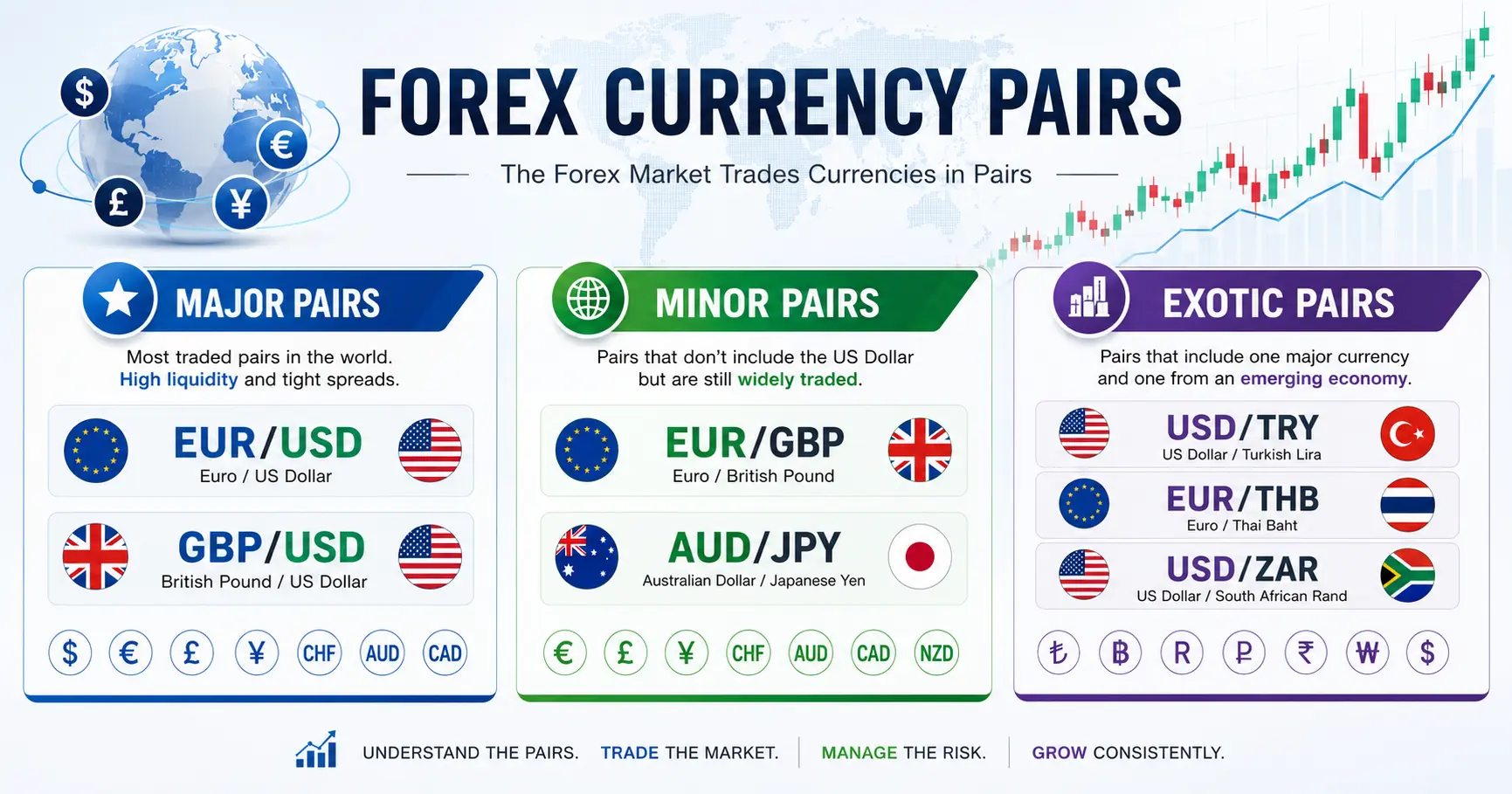
Forex currency pairs show the value of one currency compared with another. The three main types are major, minor, and exotic pairs, and each has different liquidity, spread, volatility, and risk characteristics. Understanding these categories helps traders choose markets that match their experience level, trading style, and risk tolerance. This guide explains how currency pairs work, gives practical examples, and highlights what beginners should consider before trading.
What Are Forex Currency Pairs?
A forex currency pair is a quote that compares two currencies. When you trade forex, you are buying one currency and selling another at the same time.
For example, in EUR/USD, the euro is the first currency and the US dollar is the second currency. If EUR/USD rises, it means the euro has strengthened against the US dollar, or the US dollar has weakened against the euro.
The first currency is called the base currency. The second currency is called the quote currency. A price of 1.1000 for EUR/USD means 1 euro equals 1.1000 US dollars.

Base Currency vs Quote Currency
Every forex pair has the same structure:
- Base currency: The currency being bought or sold first.
- Quote currency: The currency used to price the base currency.
For example:
GBP/USD = 1.2500
This means 1 British pound is worth 1.2500 US dollars.
If you buy GBP/USD, you are buying pounds and selling dollars. If you sell GBP/USD, you are selling pounds and buying dollars.
The Three Main Types of Forex Currency Pairs
Forex pairs are usually grouped into three categories:
- Major currency pairs
- Minor currency pairs
- Exotic currency pairs
These categories are based mainly on liquidity, global trading activity, and the currencies involved.

Major Currency Pairs
Major currency pairs include the US dollar paired with another highly traded global currency. These are often the most liquid forex pairs because they involve large economies and attract significant market participation.
Common examples of major currency pairs include:
- EUR/USD — Euro / US dollar
- USD/JPY — US dollar / Japanese yen
- GBP/USD — British pound / US dollar
- USD/CHF — US dollar / Swiss franc
- AUD/USD — Australian dollar / US dollar
- USD/CAD — US dollar / Canadian dollar
- NZD/USD — New Zealand dollar / US dollar
Source flag: If you mention exact rankings, daily volume, or percentage share by pair, verify with the latest BIS Triennial Survey or another credible institutional source.
Why Major Pairs Are Popular
Major pairs are popular because they generally offer:
- Higher liquidity
- Tighter spreads
- More market coverage
- More educational resources
- Frequent technical and fundamental analysis
This does not mean major pairs are risk-free. Prices can still move sharply during central bank decisions, inflation reports, employment data, geopolitical events, or unexpected market shocks.
Are Major Pairs Good for Beginners?
Major currency pairs are often considered more beginner-friendly than exotic pairs because they usually have tighter spreads and more available market information. However, beginners should still use risk controls, understand leverage, and avoid overtrading.
For many new traders, it is easier to start by studying one or two major pairs rather than trying to monitor many markets at once.
Minor Currency Pairs
Minor currency pairs, also called cross currency pairs, do not include the US dollar. They usually combine other major global currencies, such as the euro, British pound, Japanese yen, Swiss franc, Australian dollar, Canadian dollar, or New Zealand dollar.
Examples of minor currency pairs include:
- EUR/GBP — Euro / British pound
- EUR/JPY — Euro / Japanese yen
- GBP/JPY — British pound / Japanese yen
- AUD/JPY — Australian dollar / Japanese yen
- EUR/AUD — Euro / Australian dollar
- CHF/JPY — Swiss franc / Japanese yen
- GBP/CAD — British pound / Canadian dollar

How Minor Pairs Differ From Major Pairs
Minor pairs can still be liquid, especially when they involve widely traded currencies. However, they may have wider spreads than major pairs and can behave differently because the US dollar is not directly part of the quote.
For example, EUR/GBP is often influenced by economic conditions in the eurozone and the United Kingdom. AUD/JPY may be affected by risk sentiment, commodity trends, and interest rate expectations in Australia and Japan.
When Traders Use Minor Pairs
Traders may watch minor pairs when they want exposure to a specific economic relationship without directly trading the US dollar.
For example, a trader who has a view on the euro versus the British pound may choose EUR/GBP instead of trading EUR/USD and GBP/USD separately.
Minor pairs can also create opportunities when one currency is supported by stronger economic data, while another is pressured by weaker growth, lower interest rate expectations, or political uncertainty.
Exotic Currency Pairs
Exotic currency pairs include one major currency and one currency from a smaller, emerging, or less liquid economy. These pairs are called “exotic” because they are traded less actively than major and many minor pairs.
Examples of exotic currency pairs may include:
- USD/TRY — US dollar / Turkish lira
- USD/ZAR — US dollar / South African rand
- USD/MXN — US dollar / Mexican peso
- EUR/TRY — Euro / Turkish lira
- USD/THB — US dollar / Thai baht
- USD/SEK — US dollar / Swedish krona
- USD/NOK — US dollar / Norwegian krone
Classification can vary by broker and market convention. Some currencies may be treated as exotic by one broker but grouped differently by another.

Why Exotic Pairs Can Be Riskier
Exotic currency pairs often have:
- Lower liquidity
- Wider spreads
- Higher trading costs
- Greater sensitivity to local political and economic events
- Sharper price gaps during periods of stress
These features can make exotic pairs harder to trade, especially for beginners. Even when a move looks attractive on a chart, wider spreads and sudden volatility can affect trade execution and risk management.
What Moves Exotic Currency Pairs?
Exotic pairs may be influenced by:
- Domestic interest rate decisions
- Inflation trends
- Political instability
- Commodity prices
- Capital flows
- Central bank intervention
- External debt concerns
- Global risk sentiment
Source flag: Claims about a specific exotic currency’s drivers should be supported by central bank data, IMF reports, official economic releases, or reputable market research.
Major vs Minor vs Exotic Currency Pairs
The differences between these forex currency pairs are important because they affect costs, strategy, and risk.
| Pair Type | Includes USD? | Liquidity | Typical Spreads | Common User |
|---|---|---|---|---|
| Major pairs | Yes | High | Lower | Beginners to advanced traders |
| Minor pairs | No | Medium to high | Moderate | Beginner to intermediate traders |
| Exotic pairs | Sometimes | Lower | Wider | Experienced traders |

Liquidity
Liquidity refers to how easily a currency pair can be bought or sold without a major price impact. Major pairs generally have the highest liquidity because they involve widely traded currencies and large market participation.
Higher liquidity can support tighter spreads and smoother execution, although this can change during high-impact news events or periods of market stress.
Spreads
The spread is the difference between the bid price and the ask price. It is one of the main trading costs in forex.
Major pairs often have tighter spreads. Minor pairs may have moderate spreads. Exotic pairs often have wider spreads because fewer buyers and sellers are active at any given time.
Volatility
Volatility describes how much a currency pair moves over a given period. Higher volatility can create trading opportunities, but it also increases risk.
Exotic pairs can be more volatile, but major pairs can also move sharply around major news releases, central bank announcements, or unexpected global events.
How to Choose Forex Pairs as a Beginner
Beginners should not choose forex pairs only because they appear to move a lot. A better approach is to focus on clarity, costs, and risk control.

1. Start With Liquid Pairs
Many beginners start with major currency pairs because they tend to have more liquidity, tighter spreads, and more accessible market analysis. EUR/USD, GBP/USD, and USD/JPY are commonly watched examples.
This does not mean these pairs are easy to trade. It only means that information and pricing are usually more transparent than in less liquid markets.
2. Understand What Drives the Pair
Before trading a pair, understand the main economic factors behind it. These may include:
- Interest rate expectations
- Inflation data
- Employment reports
- Gross domestic product growth
- Central bank policy
- Commodity prices
- Political risk
For example, USD/CAD may be influenced by US and Canadian economic data, interest rate expectations, and oil market trends. AUD/USD may react to Australian data, China-related demand expectations, commodity sentiment, and US dollar strength.
3. Watch the Spread
A pair with a wider spread needs a larger price move before a trade can become profitable after costs. This is especially important for short-term traders.
Before entering a trade, compare the expected move with the spread, position size, and stop-loss distance.
4. Avoid Overloading Your Watchlist
Following too many forex currency pairs can lead to confusion and inconsistent decisions. Beginners may benefit from focusing on a small watchlist and learning how each pair behaves across different sessions and news events.
5. Use Risk Management
Risk management is essential in forex trading. Traders should define their position size, stop-loss level, and maximum acceptable loss before entering a trade.
Leverage can magnify both gains and losses. Never trade with money you cannot afford to lose.
Common Mistakes When Trading Currency Pairs
Chasing Volatility
High volatility may look attractive, but it can also increase the chance of slippage, emotional decisions, and fast losses. A volatile pair is not automatically a better pair.
Ignoring the Economic Calendar
Currency pairs can move quickly after central bank meetings, inflation releases, employment reports, and unexpected political developments. Traders should check the economic calendar before opening positions.
Assuming Low Spreads Mean Low Risk
A tight spread can reduce trading costs, but it does not remove market risk. Even the most liquid major pairs can move sharply in unusual conditions.
Trading Exotic Pairs Without Understanding Local Risk
Exotic currency pairs can be affected by local regulations, central bank intervention, political changes, and lower liquidity. Traders should research the specific country and currency before trading.
Frequently Asked Questions
Major forex currency pairs are pairs that include the US dollar and another widely traded currency. Examples include EUR/USD, USD/JPY, GBP/USD, USD/CHF, AUD/USD, USD/CAD, and NZD/USD.
Major currency pairs include the US dollar, while minor currency pairs do not. Minor pairs, also called crosses, usually combine other major currencies, such as EUR/GBP, EUR/JPY, and GBP/JPY.
Exotic currency pairs are generally less suitable for beginners because they often have lower liquidity, wider spreads, and higher sensitivity to local economic or political events. Beginners usually benefit from studying more liquid pairs first.
There is no single best forex pair for every beginner. Many new traders start with major pairs because they tend to have tighter spreads, more liquidity, and more available analysis. The right choice depends on trading goals, risk tolerance, and strategy.
Spreads differ because of liquidity, market demand, volatility, broker pricing, and trading session activity. Highly liquid pairs often have tighter spreads, while less liquid or more volatile pairs may have wider spreads.
Conclusion + CTA
Understanding forex currency pairs is one of the first steps in learning how the forex market works. Major pairs are usually the most liquid, minor pairs offer non-USD opportunities, and exotic pairs can carry higher costs and risks. Rather than trying to trade every pair, beginners should focus on a small watchlist, learn what moves each market, and apply consistent risk management.
To continue learning, read our beginner guide to forex trading and build a simple watchlist before placing any live trades.
Risk Disclaimer
Forex trading involves significant risk and is not suitable for all investors. Currency prices can move quickly, and leverage can magnify both profits and losses. This article is for educational purposes only and does not constitute financial advice, investment advice, or a recommendation to buy or sell any currency pair. Always conduct your own research and consider speaking with a qualified financial professional before trading.