
 PIPAVO Team
Learn key forex terms like pip, lot, leverage, margin, and spread with simple examples, risk notes, and beginner-friendly explanations.
In this article
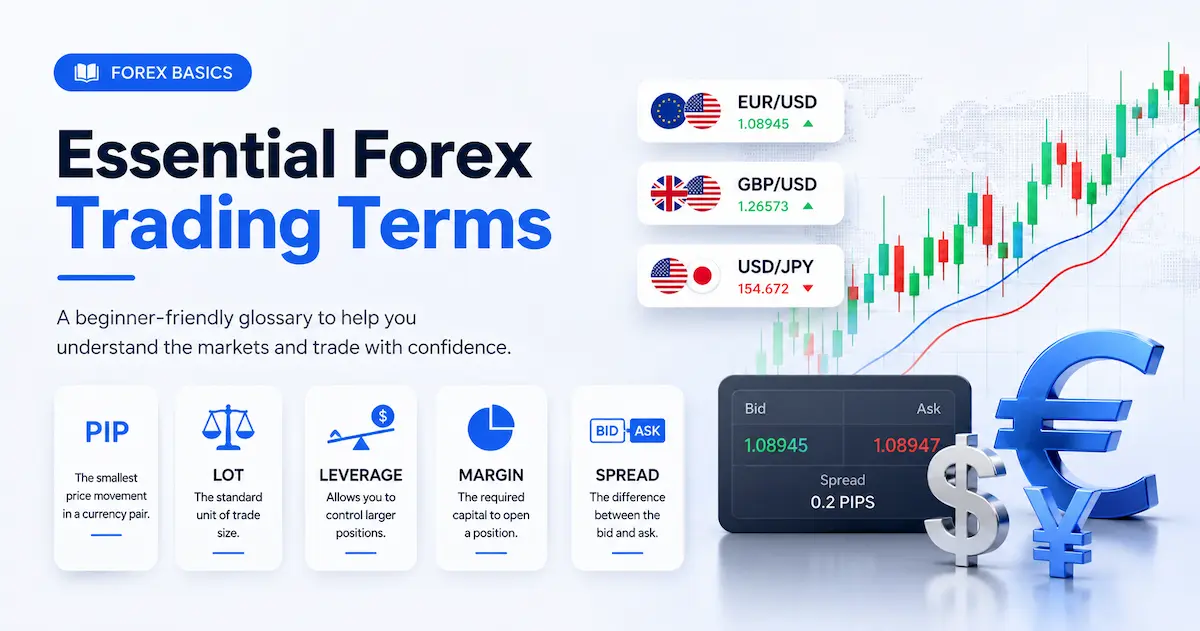
Understanding essential forex terms is one of the first steps toward reading price quotes, using a trading platform, and managing risk more responsibly. Terms like pip, lot, leverage, margin, and spread appear in almost every forex trade.
This guide explains each term in plain English, with simple examples and risk notes. It is designed for beginners who want clarity before they trade, not promises of profit.
Why Forex Terms Matter
Forex trading uses its own language. At first, the terms can seem technical, but most of them describe simple ideas: how prices move, how large your trade is, how much capital is required, and what costs may apply.
Learning these terms matters because small misunderstandings can lead to large mistakes. For example, confusing leverage with margin may cause a trader to take on more exposure than expected. Misreading a pip value can also make a trade look smaller or safer than it really is.
Before using any live trading account, beginners should understand how each term affects both potential profit and potential loss.

What Is a Pip in Forex?
A pip is a standard unit used to measure price movement in forex. For most major currency pairs, one pip equals a movement of 0.0001 in the exchange rate.
For example, if EUR/USD moves from 1.0850 to 1.0851, that is a movement of 1 pip.
For pairs involving the Japanese yen, a pip is usually measured at the second decimal place. For example, if USD/JPY moves from 157.20 to 157.21, that is a movement of 1 pip.
Why Pips Matter
Pips help traders measure price changes, compare trade setups, and calculate gains or losses. Instead of saying “the price moved by 0.0007,” traders may say “the price moved 7 pips.”
A pip does not always equal the same amount of money. Its value depends on the currency pair, trade size, and account currency.
Pip Example
Suppose you buy EUR/USD at 1.0850 and close the trade at 1.0870.
The price moved:
1.0870 - 1.0850 = 0.0020
That equals 20 pips.
Whether that 20-pip move results in a small or large gain depends on your lot size.

What Is a Lot in Forex?
A lot is the unit size of a forex trade. It tells you how much currency you are buying or selling.
The most common lot sizes are:
| Lot Type | Units of Base Currency |
|---|---|
| Standard lot | 100,000 units |
| Mini lot | 10,000 units |
| Micro lot | 1,000 units |
| Nano lot | 100 units |
The base currency is the first currency in a pair. In EUR/USD, the base currency is EUR. In GBP/USD, the base currency is GBP.
Why Lot Size Matters
Lot size affects how much money each pip movement is worth. A larger lot size means each pip movement has a larger impact on your account.
For beginners, this is one of the most important risk concepts in forex. A trade can look small on the screen, but if the lot size is too large, even a small price move can cause a significant loss.
Simple Lot Size Example
If you trade EUR/USD:
- A standard lot is 100,000 EUR
- A mini lot is 10,000 EUR
- A micro lot is 1,000 EUR
A micro lot usually gives beginners more room to learn because each pip movement is smaller in money terms than with a mini or standard lot.
What Is Leverage in Forex?
Leverage allows a trader to control a larger position with a smaller amount of capital. It is usually shown as a ratio, such as 10:1, 30:1, 50:1, or 100:1.
For example, with 50:1 leverage, a trader may control a position worth $50,000 with $1,000 of required capital.
Leverage can increase potential returns, but it also increases potential losses. It does not reduce risk. It magnifies exposure.
Leverage Example
Imagine you have $1,000 in your trading account and use 50:1 leverage.
That means you may be able to control up to:
$1,000 × 50 = $50,000
If the market moves in your favor, the result is based on the larger $50,000 exposure. If the market moves against you, the loss is also based on that larger exposure.
This is why leverage should be used carefully, especially by beginners.

Why Leverage Is Risky
Leverage can make normal market movement feel much larger. A small move against a highly leveraged position may quickly reduce account equity.
This is especially important in fast-moving markets, during major economic announcements, or when liquidity is low. Slippage, widening spreads, and rapid price moves can increase risk.
Claim needing source before publication: If you mention a specific maximum leverage limit by country or regulator, cite the relevant regulator or broker disclosure page because leverage rules vary by jurisdiction and account type.
What Is Margin in Forex?
Margin is the amount of money required to open and maintain a leveraged position. It is not a fee. It is a deposit or collateral set aside by the broker while the trade is open.
Leverage and margin are connected. If leverage tells you how much exposure you can control, margin tells you how much capital is required to control that exposure.
Margin Example
Suppose you want to open a $10,000 forex position and your broker requires 2% margin.
The required margin would be:
$10,000 × 2% = $200
This means $200 of your account equity is set aside to support that trade.
Margin Level and Margin Call
A margin call happens when your account equity falls too low to support your open positions. Depending on the broker’s rules, you may be required to add more funds, reduce your position size, or your broker may automatically close trades.
A stop-out occurs when the broker closes positions because account equity has fallen below a required level.
Beginners should read their broker’s margin policy carefully before trading. Margin rules can vary by broker, product, account type, and jurisdiction.

What Is Spread in Forex?
The spread is the difference between the bid price and the ask price.
- The bid price is the price at which you can sell.
- The ask price is the price at which you can buy.
For example, if EUR/USD is quoted as:
Bid: 1.0850
Ask: 1.0852
The spread is:
1.0852 - 1.0850 = 0.0002
That equals 2 pips.
Why Spread Matters
The spread is one of the main trading costs in forex. When you enter a trade, the market must move enough to cover the spread before the position can become profitable, excluding any other costs or fees.
Spreads may be tighter during active market hours and wider during low-liquidity periods or major news events.
Fixed vs Variable Spread
Some brokers offer fixed spreads, while others offer variable spreads.
A fixed spread is designed to stay the same under normal conditions. A variable spread can change based on market liquidity and volatility.
Beginners should understand how their broker charges trading costs. Some accounts have wider spreads with no commission. Others have tighter spreads but charge a separate commission.

How These Forex Terms Work Together
Pip, lot, leverage, margin, and spread are connected. They do not work in isolation.
Here is a simple example:
You open a EUR/USD trade with:
- Entry price: 1.0850
- Trade size: 1 mini lot
- Leverage: 30:1
- Spread: 1 pip
- Stop loss: 20 pips
In this trade:
- The pip measures the price movement.
- The lot size determines how much each pip is worth.
- The leverage increases the market exposure you control.
- The margin is the capital required to open the position.
- The spread is part of the trading cost.
A trader who understands all five terms can better estimate risk before entering a position.

Beginner Risk Checklist Before Placing a Forex Trade
Before opening a forex trade, beginners should ask:
1. What is my lot size?
Know whether you are trading a micro, mini, or standard lot. Larger lot sizes increase the value of each pip movement.
2. How many pips am I risking?
If you use a stop loss, calculate the distance between your entry price and stop-loss level.
3. What is the pip value?
Understand how much money may be gained or lost for each pip movement.
4. How much leverage am I using?
Higher leverage increases exposure. Lower leverage may reduce the speed at which losses affect your account.
5. What margin is required?
Check how much account equity is needed to open and maintain the position.
6. What is the spread?
A wider spread increases your trading cost and may affect short-term strategies more than longer-term trades.
7. What is the worst-case scenario?
Markets can move quickly. Price gaps, slippage, and volatility can cause losses larger than expected.
Common Mistakes Beginners Make With Forex Terms
Mistake 1: Thinking Leverage Is Free Buying Power
Leverage is not free money. It is increased exposure. The larger the exposure, the faster gains and losses can change.
Mistake 2: Ignoring Lot Size
Many beginners focus only on the direction of the trade and forget the size of the trade. Risk is not only about being right or wrong. It is also about how much is at stake.
Mistake 3: Underestimating the Spread
A spread may seem small, but it matters, especially for frequent trading or short-term strategies.
Mistake 4: Confusing Margin With a Fee
Margin is not a trading fee. It is collateral required to keep a leveraged trade open.
Mistake 5: Trading Without Calculating Pip Value
Before placing a trade, beginners should understand what each pip is worth in account currency.
Frequently Asked Questions
The most important forex terms for beginners include pip, lot, leverage, margin, spread, bid price, ask price, stop loss, and currency pair. These terms help explain how trades are priced, sized, opened, and managed.
Leverage is the ratio that shows how much market exposure you can control with your capital. Margin is the amount of money required to open and maintain that leveraged position.
Not necessarily. A higher lot size increases the value of each pip movement, which can increase both potential gains and potential losses. Beginners often start with smaller lot sizes to better manage risk.
The spread is the difference between the bid price and the ask price. It is one of the main trading costs in forex and can change depending on market conditions and broker pricing.
Yes. Leverage can make forex trading riskier because it magnifies exposure. This means both gains and losses can increase quickly, especially during volatile market conditions.
Conclusion + CTA
Learning essential forex terms can help beginners read trading platforms more clearly and understand the risks behind each trade. Pip, lot, leverage, margin, and spread are not just definitions. They directly affect trade size, cost, exposure, and potential loss.
Before trading live, practice calculating pip value, lot size, margin requirements, and spread costs using a demo account or educational calculator.
CTA: Continue learning with our beginner guide to forex risk management before placing your first live trade.
Risk Disclaimer
Forex trading involves significant risk and is not suitable for all investors. Leverage can magnify both gains and losses, and you may lose some or all of your trading capital. This article is for educational purposes only and does not provide financial, investment, tax, or legal advice. Past performance does not guarantee future results. Always consider your financial situation, risk tolerance, and local regulations before trading. Consult a licensed financial professional if needed.